
Guide, published 14 September 2026, updated 15 September 2026
How private condo lessons map to SwimSafer stages, and where to get assessed
You can learn every SwimSafer skill at your own pool. The assessment itself happens elsewhere. Here is how the two fit together.
By the Swimming Lessons Singapore team, the people behind Happy Fish Swim School, our sister swim school.
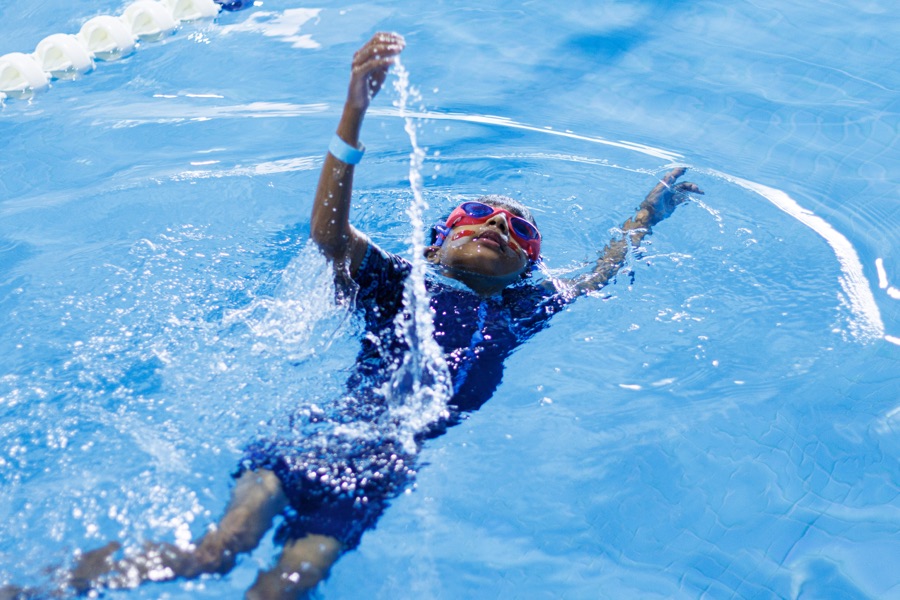
Private swimming lessons at a condo pool can teach the SwimSafer 2.0 syllabus exactly as a swim school does: the same skills, in the same order, for Stage 1, Stage 2, Stage 3, Bronze, Silver and Gold. The difference is that the assessment cannot happen at your condo. It has to be conducted by a registered assessor at an approved venue. Many coaches offering kids and teens lessons on this site work to the SwimSafer checklist, and their profiles say so; with a coach like that, assessment day is a formality.
What is SwimSafer, briefly?
SwimSafer 2.0 is Singapore's national water-safety and swimming programme. It has six progressive stages. Stage 1, Stage 2 and Stage 3 build survival skills and the basic strokes; Bronze, Silver and Gold extend distance, add rescue and survival skills, and refine all four strokes. The programme recommends a minimum age of 6. For the full programme description, see the explainer on Happy Fish SwimSafer, from Happy Fish Swim School, our sister swim school; this guide covers only the private-lesson side.
What is SwimSafer Stage 1, and can it be learned at a condo pool?
Stage 1 is about being safe and comfortable in water: entering and exiting safely, submerging and blowing bubbles, floating on front and back, gliding, a short distance of front and back movement, and basic personal water safety such as treading or floating for a short time. Every one of those skills can be taught at a condo lap pool or a children's pool, and they are often learned faster there than in a group, because the coach's hands are on the child for the whole 45 minutes.
Stage 2 and Stage 3 add longer distances on freestyle and backstroke, an introduction to breaststroke, deeper-water skills and survival sequences. A condo lap pool of 25 metres or more is ideal; a shorter pool still works for technique, with distance built in repeated lengths.
How many private lessons per SwimSafer stage?
Nobody can give you a precise number. What swim teachers commonly observe, for a child of 6 or 7 with weekly 45-minute private lessons and a little practice in between, is roughly this:
| Stage | What is being built | What coaches typically see |
|---|---|---|
| Readiness (under 6) | Water confidence, floats, glides | One or two packages of play-based lessons |
| Stage 1 | Safe entry, submersion, floating, short distance | Often one 8-lesson package for a beginner who is ready |
| Stage 2 | Longer freestyle and backstroke, survival skills | One to two packages, depending on practice |
| Stage 3 | All strokes introduced, deeper water, longer distances | Two packages is common; breaststroke timing is the slow part |
| Bronze to Gold | Distance, endurance, rescue and survival, stroke refinement | Months per level; endurance needs pool time beyond lessons |
Children who swim with a parent between lessons, even 15 minutes of practising last week's drill, move noticeably faster than those who see water only with the coach. Twice-weekly lessons roughly halve the calendar time.
How do I get SwimSafer Gold, or any certificate, from private lessons?
Assessments must be conducted by a SwimSafer-registered assessor at an approved pool, so a condo coach cannot assess your child at your pool. When your coach judges that your child can perform every skill on the stage checklist reliably, book an assessment with a provider that runs SwimSafer assessments; many swim schools do, including Happy Fish Swim School, our sister swim school. The child attends, performs the skills, and the certificate is issued in the usual way. A child whose coach has been ticking off the same checklist week by week usually arrives well prepared.
Gold specifically takes time and pool volume. By that level a learner needs to swim continuous distances in all four strokes, so many families combine private technique lessons with lap practice at their own pool or a squad.
Does a private coach follow the same syllabus as a group class?
Not always. Coaches on this site are independent, and each teaches in their own way. Many work to the SwimSafer 2.0 syllabus and say so in their profile. Some teach their own progression, which is not wrong but can make an assessment a surprise. Check the profile, and at the trial lesson ask which stage checklist the coach works to. The short note the coach adds after each lesson shows which skills were worked on, so you can see the checklist filling up.
Is a condo pool deep enough for the later stages?
Most condo lap pools are 1.2 to 1.5 metres, which covers Stage 1 through Stage 3 comfortably. Some later-stage skills, such as surface dives and deep-water survival sequences, are best practised in deeper water. If your pool has a deep end the coach can use it; if not, those specific skills are best polished in a deeper pool before the assessment.
Build the stages at your own pool
Weekly private lessons at your own pool, with a coach who works to the SwimSafer checklist. Check the profile before you book.