
Guide, published 14 September 2026, updated 15 September 2026
Learning to swim as an adult with a fear of water
You are not unusual, you are not too old, and nothing should be done to you without warning. Here is how the first four lessons usually go.
By the Swimming Lessons Singapore team, the people behind Happy Fish Swim School, our sister swim school.
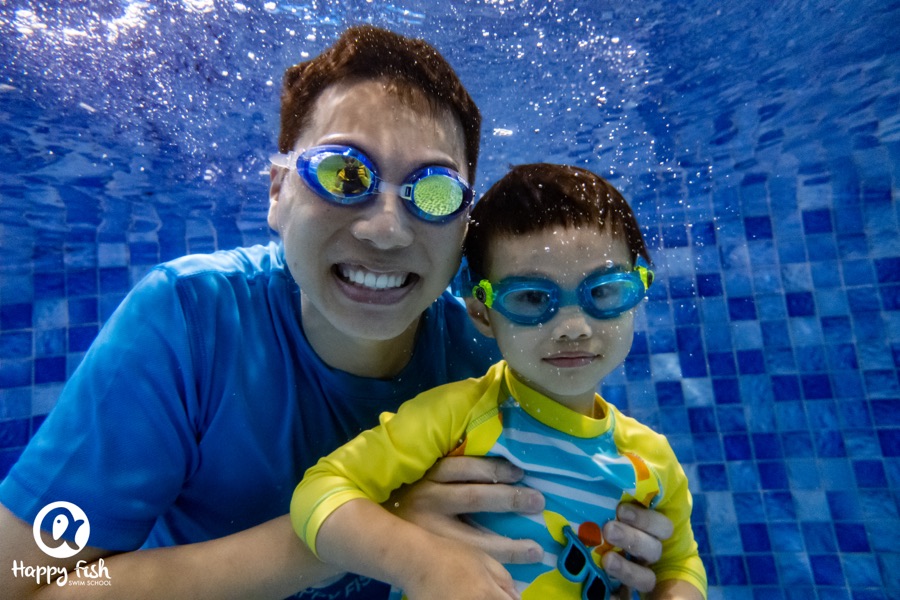
Adults who are afraid of water can learn to swim, and many are gliding by the fourth lesson. The method is not bravery. It is standing-depth water, a coach who explains every step before it happens, breathing practice before any floating, and floating before any swimming. Private adult swimming lessons at your own condo pool, often in the evening when it is empty, remove the audience that stops many adults from ever starting.
Am I too old to learn to swim?
No. Coaches teach adults in their twenties and adults in their sixties and seventies, and the method is the same. Older learners often do better than teenagers because they listen, ask questions and practise. The only age-related adjustments are medical: if you have a heart condition, high blood pressure, asthma or a joint problem, tell your doctor you are starting and tell your coach what they said. Neither is a reason not to swim; both are reasons to go at your own pace.
Why am I afraid, and does it matter?
Most adult fear of water comes from one of three places: a frightening experience as a child, never having been in water deeper than the waist, or a parent who was afraid and passed it on. It helps to name which one is yours, because it changes the first lesson. Someone who once went under and panicked needs to relearn that surfacing is easy. Someone who has simply never floated needs to feel, slowly, that the water holds them up. Neither needs to be pushed. A good coach treats fear as information, not as something to get over, and does nothing, not even a shoulder dip, without saying so first.
What do the first four lessons look like?
Every learner is different, so treat this as the shape a careful coach usually follows rather than a script.
| Lesson | Where | What happens |
|---|---|---|
| 1 | Steps and shallow end, standing | Talking, walking in the water, wetting the face, blowing bubbles with the mouth then the nose in. Holding the wall. Nothing else. |
| 2 | Standing depth | Breathing out under water for longer, bobbing with the wall, letting the feet come off the floor for a second while holding the coach's hands. |
| 3 | Standing depth | Front float with support, then with a fingertip, then a moment alone. Standing up from a float, which is the skill that ends the fear. |
| 4 | Standing depth | Back float with support, push and glide from the wall towards the coach, and usually a first laugh. |
Some adults do this in two lessons. Some need eight. Both are normal, and a good coach slows down or speeds up without comment.
How long does it take an adult to learn to swim if they are afraid?
Expect a few more lessons at the start than an unafraid beginner, then a similar pace. Coaches commonly see fearful adults floating and gliding by lesson four to six, and swimming a short distance of freestyle with breathing somewhere in the second package. The how-many-lessons guide gives the broader picture. What speeds it up is practising the breathing between lessons: a bowl of water at the kitchen sink is enough to rehearse blowing bubbles with the face in.
Why your own condo pool is the right place
Fear of water is often really fear of being watched while afraid. A public pool at 7 pm is busy, noisy and full of confident swimmers. Your condo pool at 8 pm is usually empty. There is no lane etiquette, no stranger in the next lane, no walk from the changing room past a crowd, and you go home in a towel. Many coaches teach in the evening, so lessons fit after work. You can also filter for a male or female coach, which matters to many adults; the site adds no surcharge either way, and the ladies page covers lessons with a female coach.
What should I bring, and what should I tell the coach?
Bring goggles. Water in the eyes is the biggest single trigger for panic, and a pair that fits removes it. A swimsuit or jammers, or board shorts and a rash guard, or a burkini; whatever you are comfortable in. A cap keeps hair out of your face. Tell the coach, in the learner notes and again before you get in, what you are afraid of and what you want to be able to do, whether that is a lap, a holiday, or simply being able to stand in a pool with your children. Then let the coach set the pace. Nobody has ever been made to swim by being told to relax; they are made to swim by being given, one at a time, reasons to.
Take the first lesson at your own pool
Evening slots, male or female coach, standing-depth water and nothing done without warning. Start with one trial lesson.