
Guide, published 14 September 2026, updated 15 September 2026
How many lessons does it take to learn to swim?
It depends on what you mean by swim, on age, on fear, and on whether anyone practises between lessons. Here is the honest range, not a promise.
By the Swimming Lessons Singapore team, the people behind Happy Fish Swim School, our sister swim school.
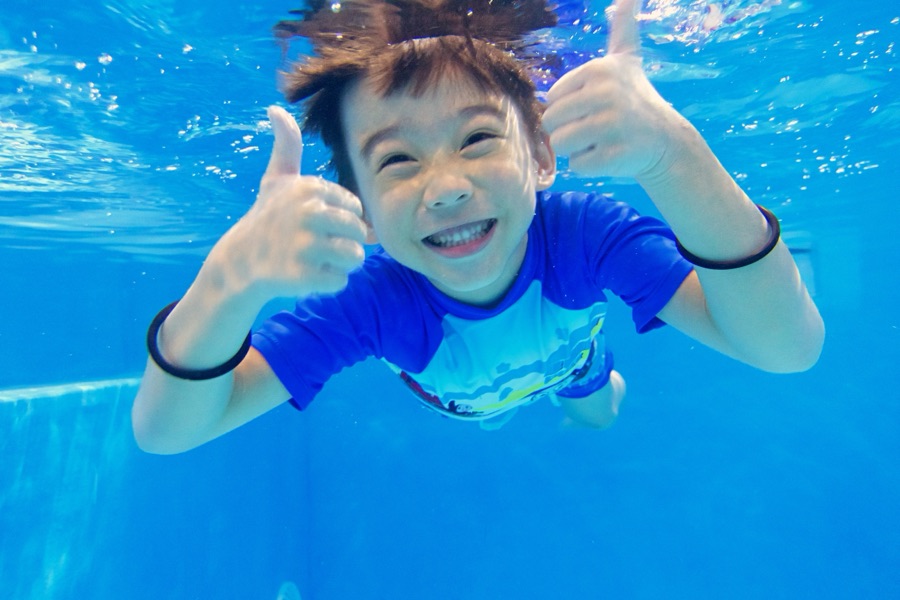
For a child of 5 to 7 with no water experience, swim teachers typically see about 8 weekly private lessons to float, glide and put the face in with confidence, and somewhere between 16 and 24 weekly lessons to swim a width of freestyle and backstroke unaided. Adults who are not afraid of water often get there faster; adults who are afraid take a few extra lessons at the start and then move quickly. Those are typical patterns for kids lessons and adult lessons, and they shift a lot with practice, frequency and what you count as swimming.
First, what does 'learn to swim' mean?
Parents usually mean one of three things, and each takes a different amount of time:
- Water-safe. Can fall in, surface, turn, float or tread, and get to the side. This is the goal that matters most and it comes first.
- Can swim a width. Freestyle or backstroke, 10 to 25 metres, with breathing, unaided. This is what most people picture.
- Swims properly. Two or more strokes over distance with decent technique, roughly SwimSafer Stage 2 to Stage 3 level. This is months of work for anyone.
Be clear which one you want before you count lessons, and tell the coach, because the plan differs.
How many swimming lessons does a child need?
With weekly 45-minute private lessons and a beginner of 5 to 7, the pattern coaches see most often is:
| Lessons | What is usually in place |
|---|---|
| 1 to 4 | Face in the water, bubbles, bobbing, safe entry and exit, supported floats |
| 5 to 8 | Unaided front and back floats, push and glide, kicking with a board across the pool |
| 9 to 16 | Freestyle arms with breathing over a few metres, back kick across the pool, treading for a count |
| 17 to 24 | A width of freestyle and backstroke unaided, first breaststroke kick, SwimSafer Stage 1 skills reliable |
Younger children, 3 and 4, take longer at the first two rows and then often catch up. Children who started in a group and already float skip the first rows entirely. Children who are frightened of water can spend a whole package on the first row, and that is money well spent, because nothing after it works until the fear is gone.
How long does it take an adult to learn to swim?
An adult beginner who is comfortable in water often floats and glides within 4 to 6 lessons and swims a 25-metre lap of freestyle with rhythmic breathing somewhere around 12 to 20 weekly lessons. The wide range is almost entirely about breathing: exhaling under water is the skill adults find hardest, and it decides everything. An adult with a real fear of water should add a few lessons at the start; the fear-of-water guide describes what those look like. Adults have one big advantage over children: they can practise deliberately between lessons, and the ones who do arrive at the next lesson with the drill already fixed.
How often should my child have swimming lessons?
Once a week is the standard and it works, provided the child sees water at least once more in the week, even 15 minutes with a parent practising last week's drill. Twice a week roughly halves the calendar time to the same milestone and is the better choice if you want a child water-safe before a holiday or the start of a school swimming programme. Less than weekly is where progress stalls; children forget the feel of the water and each lesson spends its first ten minutes going back. A holiday block can work for a specific goal, which we cover in the holiday intensive guide.
What slows learning down, and what speeds it up?
Slower: cold water, so short rests and warm slots for small children; fear, which needs patience rather than pushing; long gaps between lessons; and group lessons for a beginner, where hands-on time is a few minutes an hour. Faster: continuous correction from a coach in the water, practice between lessons, a pool the child feels safe in, and a coach who stays the same each week so no lesson is spent rebuilding trust. Private lessons at your own pool tick most of the faster boxes, which is why the timelines above are shorter than what parents often report from group classes.
What if my child is not progressing?
Read the note the coach adds after each lesson, and ask the coach directly at the pool. Common causes are a child who is cold, a child who is scared but hiding it, and a pool that is too deep for the child to rest. All three are fixable with a change of slot, pace or pool. If a coach and a learner simply do not click, try a trial lesson with another coach. You can cancel the rest of a package at any time, and every lesson 24 hours or more away is refunded.
Start counting from lesson one
A weekly slot at your own pool with the same coach, and a short note after every lesson so you can see progress happening.